

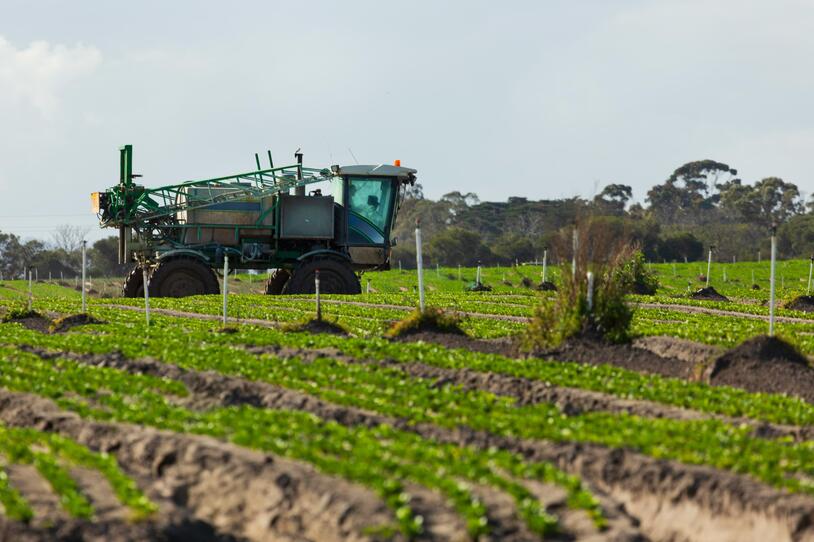
On March 3, 2026, Syngenta, one of the world’s largest pesticide manufacturers, announced that it will stop producing paraquat, a highly toxic weedkiller linked to increased risk of Parkinson’s disease.
The Michael J. Fox Foundation (MJFF) and our nationwide network of advocates have called for a national ban on paraquat in the United States for more than a decade. To help put Syngenta’s paraquat news into context, we spoke with Grant Cope (GC), Environmental Health Policy Lead at MJFF.
MJFF: What exactly did Syngenta announce?
GC: Syngenta announced that it will shut down its paraquat production facility in Huddersfield, United Kingdom, by the end of June 2026. Although the United Kingdom is among more than 70 countries that have banned paraquat due to safety concerns, it has continued to manufacture and export it to the United States, where the chemical remains legal and widely used on crops. Syngenta is owned by the government of China, which has also implemented a national ban on paraquat.
The announcement stops short of committing Syngenta or its parent company, Sinochem, to ending paraquat sales in the United States.
MJFF: What does this mean practically for the Foundation’s efforts to ban paraquat?
GC: Decades of scientific evidence link paraquat exposure to Parkinson’s risk. Researchers have found that people who spray paraquat are more than twice as likely to develop Parkinson’s as those who apply other pesticides. People who live or work near areas where paraquat is sprayed also face a higher risk.
We welcome Syngenta’s decision to exit the paraquat production business, but it does not solve the problem. As long as paraquat remains approved for use in the United States, manufacturers abroad will continue to produce and export it here. One company stopping production does not remove paraquat from the market or prevent exposure. In fact, according to environmental groups, Sinochem exports tens of millions of pounds of paraquat to the United States each year.
It’s past time for the United States to join the growing international effort to protect brain health and eliminate this preventable Parkinson’s risk. That requires action from our federal and state governments, not just voluntary corporate decisions.
MJFF: What are the next steps for our advocacy efforts?
GC: The work to ban paraquat must continue with renewed urgency in light of this announcement. Ensuring that policymakers understand the science around paraquat — and act on it — remains one of our top public policy priorities.
At the federal level, the Environmental Protection Agency (EPA) has the authority to limit or cancel pesticide approvals when evidence shows harm to human health. In late 2022, the EPA announced a reassessment of paraquat’s safety, but that review has not been completed as of March 2026. As part of the process, MJFF and our partners submitted more than 90 scientific studies to the EPA documenting paraquat’s harmful health effects.
We continue to urge the agency to complete its review and take action consistent with the science. At the same time, Syngenta and Sinochem should unequivocally commit to stopping the sale of paraquat in the United States and voluntarily cancel their paraquat registrations with the EPA.
States also have the authority to enact their own restrictions or bans. In 2026, MJFF is advancing paraquat legislation in more than 10 states, including Illinois, Missouri, New York, Pennsylvania and Vermont.
MJFF: What can readers do?
GC: Public pressure is essential to driving change. Sign up for MJFF’s Parkinson’s Policy Network (PPN) to receive action alerts at moments when it’s critical for the Parkinson’s community to send messages to elected officials. PPN members also receive access to advocacy resources and invitations to participate in local and national lobby days.
In just a few weeks, 350 Parkinson’s advocates will convene on Capitol Hill for the 2026 Parkinson’s Policy Forum. Attendees will meet with members of Congress to urge support for action on paraquat and for the HEALTHY BRAINS Act, a bipartisan bill that would strengthen federal research on the connection between environmental exposures and neurodegenerative diseases. Policy Forum attendees will also urge Congress to increase federal funding for Parkinson’s research and implement the National Parkinson’s Project. MJFF will share virtual participation opportunities with PPN members at home, so be sure to sign up today.
Visit banparaquat.org to learn more about our ongoing advocacy and add your name to our petition to the federal government. You can also find out where paraquat is sprayed in the United States and take steps to avoid exposure — especially if you live or work in rural areas, where paraquat use is more common.
Through strong advocacy, research investment and sustained engagement with policymakers, the Parkinson’s community continues to drive progress toward a safer environment and a future without Parkinson’s.