

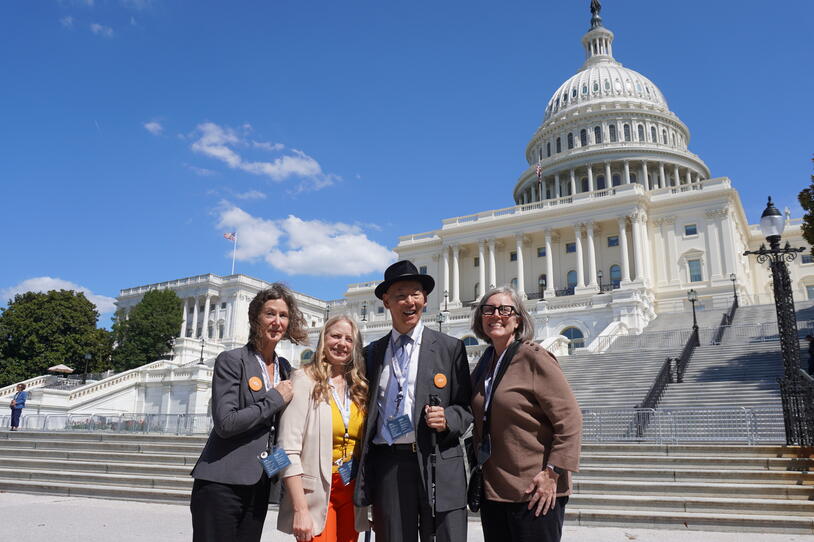
Colorado advocates at the 2025 Parkinson's Policy Forum on Capitol Hill.
Our nationwide network of policy advocates — people living with Parkinson’s, care partners, family members, clinicians, researchers and more — bring much-needed urgency and hope to public policy decisions that shape the future of Parkinson’s. And this year, our collective advocacy resulted in key progress at the state and federal levels of government. Read on to learn more about what we accomplished in 2025 and sign up to join us in 2026!
States Step Up on Parkinson’s Policy
State Research Funding
More and more states are answering our call to advance science to improve the lives of people living with Parkinson’s today and in the future. Most notably, Texas voters made history by approving a $3 billion investment in brain disease research — one of the largest commitments of its kind in the nation. In Pennsylvania, officials included $5 million for neurodegenerative disease research in the state’s annual budget. And in Florida, the legislature created a new Parkinson’s research consortium at the University of South Florida with $8 million to begin basic, clinical and translational and studies.
These landmark investments pave the way for critically needed research and reflect a growing understanding that state governments have a significant part in strengthening local research ecosystems and accelerating scientific breakthroughs. Learn more about our 2025 state policy achievements, and stay tuned as we expand our state research advocacy in 2026.
Environmental Policy Change
We began our state-wide environmental advocacy in California in 2024. This year, we partnered with the Environmental Working Group and Parkinson Foundation of Western Pennsylvania to advocate for a new bill — still under consideration — that would make the state the first in the U.S. to ban the Parkinson’s-linked herbicide, paraquat. Since then, Vermont has also introduced legislation to ban paraquat. We look forward to engaging more states on environmental legislation in 2026.
Making Parkinson’s Disease a Federal Health Care Priority
The National Parkinson’s Project
In January 2025, shortly after receiving the Presidential Medal of Freedom, Michael J. Fox authored an opinion piece in USA Today calling on the federal government to make 2025 the year it commits to ending Parkinson’s. The piece highlighted the promise of recent and ongoing scientific advances and underscored the tremendous potential of the National Parkinson’s Project (NPP).
“My journey continues to surprise me, but at its core it has always been about one thing: working hand in hand with a nationwide community to problem-solve and speed research toward better treatments and a cure for Parkinson’s disease. That’s why I’m taking my new medal out for a spin and urging America’s elected leaders to do everything in their power to end Parkinson’s once and for all,” Michael wrote.
“That’s why I’m taking my new medal out for a spin and urging America’s elected leaders to do everything in their power to end Parkinson’s once and for all.”
Authorized by The National Plan to End Parkinson’s Act — which was signed into federal law in July 2024 — the NPP is a first-ever whole-of-government federal initiative to better diagnose, treat, prevent and cure Parkinson’s disease and atypical parkinsonisms. The Parkinson’s community — including Michael! — has consistently urged The U.S. Department of Health and Human Services to develop the NPP and seat its advisory council. From calls, emails and in-person meetings with members of Congress to op-eds, social media and more, our advocacy continues into 2026.
Federal Research Funding
We also engaged Congress in conversations about the importance of sustaining and growing federal biomedical research investment. In June, MJFF partnered with the American Parkinson Disease Association and the Parkinson’s Foundation to release a joint statement urging Congress to ensure robust funding for the National Institutes of Health (NIH) — the essential engine of medical progress and hope for millions of Americans.
Later in the year, we urged advocates to join us in calling for Congress to reinstate funding for the Parkinson’s Research Program at The U.S. Department of Defense (DoD), which studies the link between Parkinson’s and military service-related risk factors. Last year’s federal budget reduced overall DoD research funding, and budget proposals for 2026 do not aim to restore any funding. Use our simple form to send a letter to your members of Congress.
On a positive note, in November, Congress approved the budget for The U.S. Department of Veterans Affairs (VA) which includes a $1.5 million increase for the Parkinson’s Disease, Research, Education and Clinical Centers. We’ve advocated for this budget boost for several years and hope the VA will use it to establish new clinical centers in areas with high populations of veterans living with Parkinson’s such as Florida and the upper Midwest.
A United Parkinson’s Community Comes Together on Capitol Hill
Advocacy came to life in Washington, D.C., as 276 Parkinson’s advocates from 45 states (and D.C.) attended our 2025 Parkinson’s Policy Forum for two action-packed days on Capitol Hill. Advocates met with lawmakers to share personal stories, connecting their lived experience with opportunities for policy change and helping policymakers better understand how federal leadership can drive meaningful impact.
“Advocacy is about standing side by side with our loved ones living with Parkinson’s to push for better care, more support and a brighter future,” said Forum attendee and speaker, Lonnie Ali, who served as a Parkinson’s care partner to her late husband, Muhammad Ali. “That united strength is what drives us closer to a cure for Parkinson’s disease.”
“Advocacy is about standing side by side with our loved ones living with Parkinson’s to push for better care, more support and a brighter future. That united strength is what drives us closer to a cure for Parkinson’s disease.”
The 2026 Parkinson’s Policy Forum will return in March. Participants will again attend in-person meetings to ask for congressional support of NPP implementation, increased federal research funding, reintroduction of the HEALTHY BRAINS Act and more.
Looking Ahead Together
In 2025, advocates showed once again that our voices matter, personal stories can inspire action and collective effort drives policy and science forward. Thanks to their passionate leadership, the Parkinson’s community enters the next year energized, united and confident in what we can continue to achieve together. Sign up for our Parkinson’s Policy Network to get involved today.