

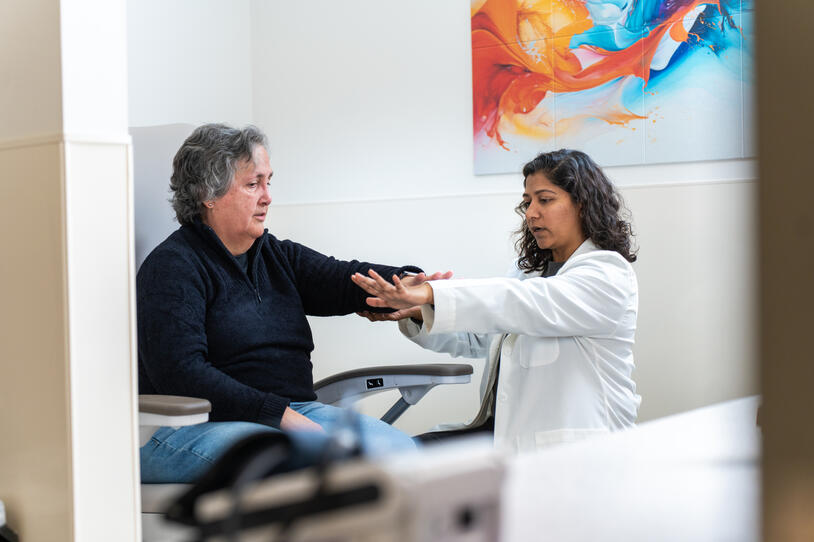
Research breakthroughs have unlocked the potential of personalized care in Parkinson's.
For more than 200 years, Parkinson’s has been largely viewed as one disease characterized primarily by movement symptoms. As anyone touched by Parkinson’s disease (PD) knows, though, the experience is highly individualized.
“Today, we know that ‘under the hood,’ there are different biological paths that may explain why symptoms and rate of progression vary from person to person,” explained Brian Fiske, PhD, chief scientist at MJFF. “Understanding those markers of biology can help us match the right treatment to the right person.”
By learning more about what’s “under the hood,” the field can move closer to precision medicine, offering personalized treatments based on changes in cells and pathways. By treating what’s happening in the body — rather than the disease label — precision medicine has the potential to increase benefit, slow progression and/or ease symptoms.
Research into the complex biology of Parkinson’s has been the goal of our landmark natural history study, the Parkinson’s Progression Markers Initiative (PPMI), since it launched in 2010. At the study’s annual meeting in May, the Foundation announced a new designation for the well-known abbreviation — the Parkinson’s Precision Medicine Initiative. Read more at right about how scientific progress has led us to this moment in renaming the study.
“We’re moving closer to therapies that help keep people with Parkinson’s stable longer and push off worsening or new symptoms,” said Andrew Siderowf, MD, chief of the Movement Disorders Division at the University of Pennsylvania and PPMI co-principal investigator. “A PD diagnosis brings a question of ‘What’s going to happen to me?’ With more disease markers and precision medicine, we can help answer that and bring hope.”
Borrowed Blueprint for Better Disease Outcomes
There’s precedent for this approach: targeted treatments based on molecular characteristics have led to advances beyond a one-size-fits-all approach for conditions like breast and lung cancer. And in Alzheimer’s disease, blood tests and brain scans have brought more targeted therapies.
Today, most approved Parkinson’s treatments (drugs like levodopa/carbidopa or surgical approaches such as deep brain stimulation) help manage symptoms like stiffness and slowness. There are no approved disease-modifying therapies — treatments that target the underlying drivers of disease to slow or stop progression — but more than 75 such treatments are in clinical testing. Some of these studies are recruiting based on genetic factors, with MJFF providing funding, recruitment and/or strategy support:
- A LRRK2 protein inhibitor, BIIB122, is being tested in multiple studies. The BEACON trial is enrolling people with PD and a LRRK2 genetic variant. And Dr. Siderowf is planning another LRRK2 trial testing multiple therapies at once.
- The NEULARK trial is screening recently diagnosed people with Parkinson’s for some factors linked to LRRK2 to test another LRRK2 inhibitor, NEU-411.
- In Germany, Kathrin Brockmann, MD, is evaluating whether prasinezumab, a drug currently in clinical testing, can slow or prevent cognitive decline in people with PD and a GBA1 gene variant, which is linked to more thinking and memory problems. (The PASADENA trial is testing this drug for impact on movement progression in a general PD population.)
Prevention as the Future of Precision Medicine
In 2023, MJFF announced validation of the alpha-synuclein seed amplification assay (SAA). With this tool, researchers can detect abnormal alpha-synuclein protein activity, which scientists believe causes cell death and symptoms in PD. Data from PPMI showed positive SAA in spinal fluid not only from people diagnosed but also from some individuals not yet showing clinical symptoms.
With tools like the alpha-synuclein SAA allowing earlier detection, the field can move closer to early intervention, slowing disease even before the cardinal movement symptoms arise. MJFF and partners are planning such a trial.
“If there’s evidence of disease biology, like a positive SAA or brain scan showing decreased dopamine levels,” Dr. Siderowf explained, “we can test a treatment to prevent a person from developing symptoms or delay that age of onset.”
Foundation Programs Form the Backbone for Discovery
Other MJFF-funded efforts such as the LRRK2 Investigative Therapeutics Exchange and the Global Parkinson’s Genetics Program, a resource of the Aligning Science Across Parkinson’s initiative, are driving discovery of disease markers and precision medicine targets. Programs like our Targets to Therapies and Therapeutic Pipeline Program initiatives lay a path for scientists to translate biological findings into future treatment possibilities. And PPMI’s vast biobank and dataset are helping researchers gain insights into the different biological signals of disease and their ties to the lived experience of PD.
“The real aim of therapies is to make people feel and function better or keep them well,” said Dr. Fiske. “We match biology to the disease experience to understand how a precision approach may meaningfully impact a person living with Parkinson’s.”
Each of these programs relies on contributions from people with Parkinson’s to help learn about this complex disease and test new therapies. Rick Grant, from Bel Air, Maryland, stepped up. He participates in PPMI, and his LRRK2 variant made him eligible to join a drug trial.
“If we can strike Parkinson’s out right now — if my children don’t have to have it or my grandchildren don’t have to have it, if we make one person better — we’ve done our job,” Grant said.