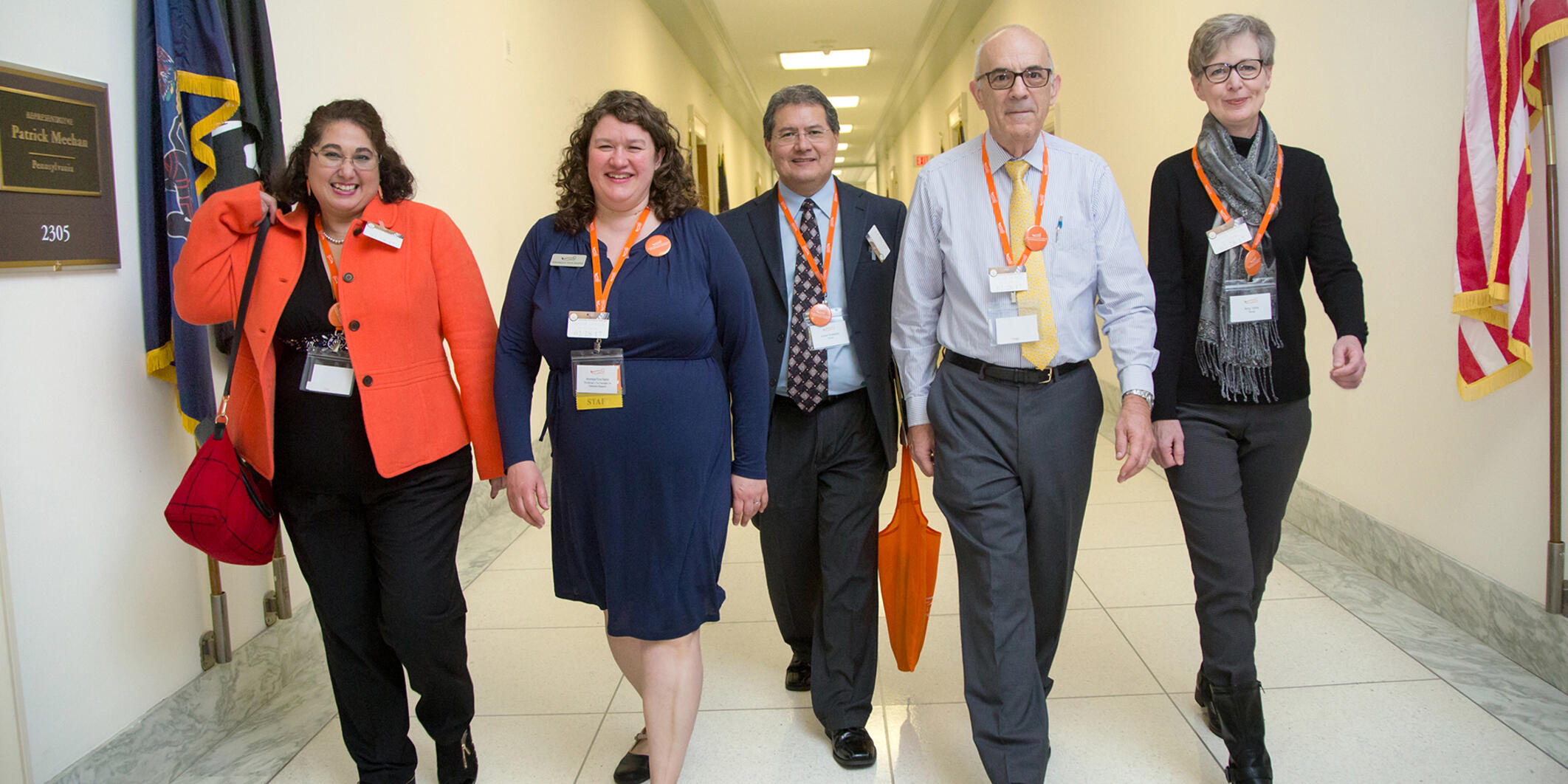
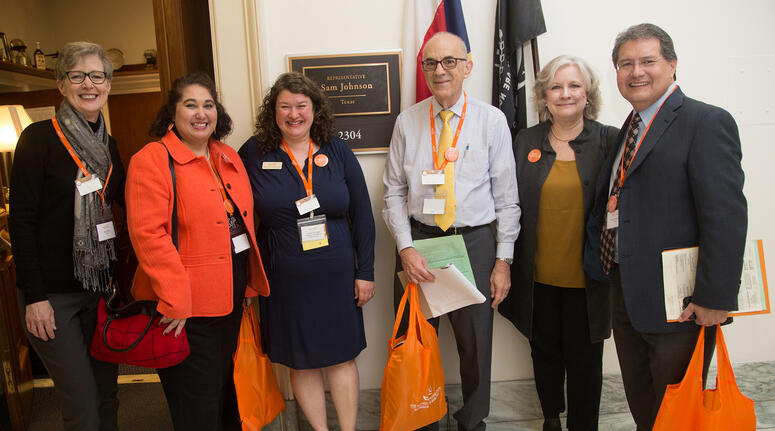
Community StoriesAdvocate Israel Robledo (center) visits local legislative offices to share his story as a person with Parkinson’s and encourage elected officials to take action.
Israel Robledo
From Patient to Policy Leader
Written by Brenna Callahan
For nearly two decades, Israel Robledo has worked to amplify the voices of people living with Parkinson’s (PD) to shape both scientific research and national policy. Following his appointment to the National Parkinson’s Project (NPP) Advisory Council, the longtime advocate and MJFF Patient Council member reflects on the power of patient-led research, the urgency of federal action and his promise to ensure no one in the Parkinson’s community is left behind.
MJFF: You’ve been involved in Parkinson’s advocacy for nearly two decades, from research participation advocacy to serving on MJFF’s Patient Council. What does being an advocate mean to you, and how does your new appointment to the NPP Advisory Council build on that work?
Israel Robledo: Being an advocate, for me, means taking on the responsibility to learn as much as possible about research while staying focused on the needs of people living with Parkinson’s and understanding what matters most to them.
My appointment to the National Parkinson’s Project Advisory Council builds on years of work, mostly behind the scenes, asking to be part of the scientific research process, providing input and helping promote clinical research participation. We’ve moved away from thinking of people with Parkinson’s as “volunteers” because we know the value they bring to research. When people with Parkinson’s are included in developing study protocols and research plans, it creates better opportunities for participation and outreach across the country.
It’s one thing to read about Parkinson’s, and another to hear our stories. That’s why I believe it’s so important for patients to be heard directly, not just represented secondhand, and I hope to bring that perspective to the NPP Advisory Council.
I think of advocacy as a shared responsibility because researchers rely on participants, and participants rely on researchers to answer important questions. When that partnership breaks down, trials can be delayed or canceled, which hurts everyone. Thankfully, efforts like Fox Trial Finder have helped connect people to research opportunities and get questions answered sooner.
Israel (far right) joins others to advocate for better Parkinson’s policies.
That advocacy extends to policy, too. This past March, I traveled to Washington, D.C. to represent Texas at the 2026 Parkinson’s Policy Forum, and I saw firsthand how much it matters when policymakers hear from patients. It’s one thing to read about Parkinson’s, and another to hear our stories. That’s why I believe it’s so important for patients to be heard directly, not just represented secondhand, and I hope to bring that perspective to the NPP Advisory Council as well.
MJFF: As someone living with Parkinson’s, what shapes the perspective you bring to the NPP Advisory Council’s discussions, particularly when representing the needs and experiences of people and families affected by the disease?
Israel: I was diagnosed with Parkinson’s almost two decades ago, so my perspective comes from seeing the challenges people face every day, from both motor and non-motor symptoms, and from understanding the realities care partners and families navigate as well.
I’ve spent years listening to people in the Parkinson’s community, and that really came into focus as I read public comments and watched video submissions the community shared with the NPP Advisory Council for our consideration. People from all walks of life took the time to share their experiences, what they need and what they hope will come of the NPP. After hearing those stories, my message to the Advisory Council was simple: Our people are hurting, and they need our help.
MJFF: You often speak about the importance of ensuring that every person with Parkinson’s is “accounted for.” When you think about the NPP, what outcomes do you think would make the biggest difference in the lives of patients, care partners and family members?
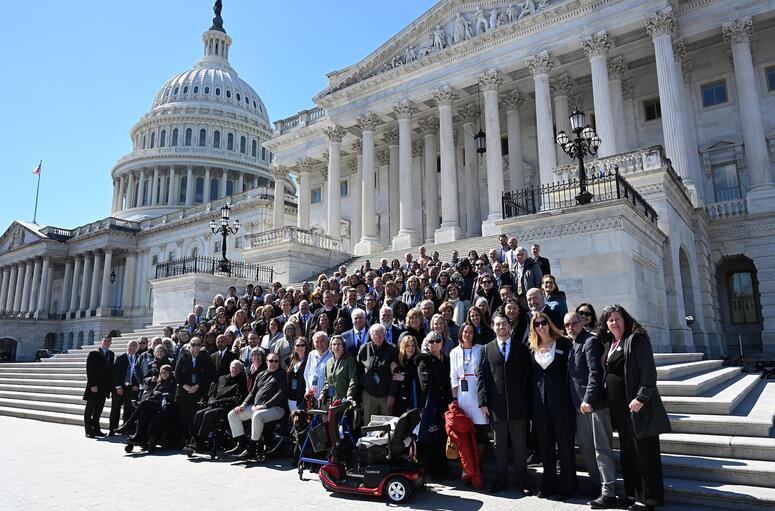
Advocates for Parkinson’s policy find strength and progress in numbers.
Israel: That is my promise to our PD community: making sure we’re all accounted for in this process. Being accounted for means making sure their needs, and the needs of their care partners and families, are reflected in the work we do on the NPP Advisory Council. We want a cure, of course, but there are people living in advanced stages of Parkinson’s that we can’t forget.
Awareness goes a long way, and I think that will be a key part of the NPP — helping people learn about all the federal agencies that fund research, as well as the ones that offer services for people with Parkinson’s. We should see a change in this area, with more people learning about and accessing the resources and services available to help them.
MJFF: Looking ahead, what do you hope the NPP will achieve for the Parkinson’s community in the long term, and what gives you the most hope about this effort?
Israel: The law behind the NPP isn’t the first disease-specific law federal agencies have enacted. The Alzheimer’s community, with their own national plan, gives us a road map of what is possible. I’m not implying in any way that we follow their plan, because the Parkinson’s community has a much wider range of issues in the motor and non-motor areas. But as the Advisory Council continues its work, I’m hopeful we can reference what has and hasn’t worked in the Alzheimer’s plan to help us avoid similar pitfalls.
Long-term achievements when it comes to care and services should be measurable. Feedback from participants should give the Council an opportunity to make changes along the way. I’ve been saying that the NPP, as it’s developed, is a “National Plan with the weight of law behind it.”
What I’ve dreamed of for years is seeing stakeholders, federal agencies, foundations and community organizations in the same room, sharing what they’re doing, listening to one another and being willing to get outside their comfort zones. It is not easy working on a multi-prong approach with so many moving parts, but we have been placed in a unique position to move in the right direction for all of us. I’m optimistic that the NPP can achieve great outcomes for all of us living with or affected by Parkinson’s disease.
Become an Advocate
Join the Parkinson’s Policy Network and make a difference in the search for better treatments and a cure for Parkinson’s.
We use cookies to ensure that you get the best experience. By continuing to use this website, you indicate that you have read our
Terms of Service and Privacy Policy.