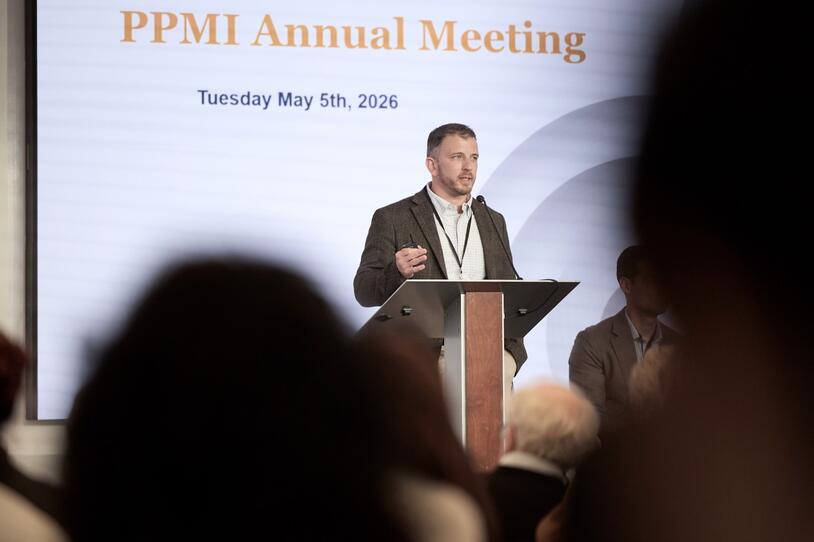
Dr. Thomas Tropea, Chief Medical Officer, Institute for Neurodegenerative Disorders
“PPMI has opened doors to a future that we had hoped for but did not know would be possible,” reflected Sohini Chowdhury, Chief Program Officer of The Michael J. Fox Foundation (MJFF), to a room of 300+ research partners. “Your contributions have enabled this study to evolve and push the field forward.”
This year’s 16th annual meeting of the Parkinson’s Precision Medicine Initiative, or PPMI, felt palpably energetic and inspiring, a tall order for an event that is already known for its unique camaraderie and rich research. Even longtime attendees felt a difference, an excitement that spilled outside the venue, overheard in earnest research discussions on the streets of New York City and in hotel elevators.
The annual event brings together researchers, staff from 50 study sites around the world, industry, investors and importantly, study participants who sit on the PPMI Community Advisory Board (CAB).

First-year CAB member Hari Subramaniam noted, “We are not just contributing our time and samples for the study, but instead, our inputs, questions and concerns seem key to this group of professionals. That felt special.”
A New Name
Part of the buzz around the meeting centered on PPMI’s new name. What was formerly the Parkinson’s Progression Markers Initiative had become the Parkinson’s Precision Medicine Initiative. This change is not a rebrand but a testament to where the science has come.
Finding a cure for Parkinson’s is a long-term commitment — built into the design of PPMI — the first-ever observational study to follow people with Parkinson’s, as well as people with risk factors for Parkinson’s and control volunteers, over many years. Data collected from the study (from over 4,200 in-person participants and nearly 50,000 who contribute online) has enabled a future where treatments for Parkinson’s are not “one size fits all” but can be tailored to every person’s unique biology, genetics, environment and lifestyle.
Not yet part of PPMI? Find your path today at michaeljfox.org/ppmi.
The study itself has not changed. PPMI is still an observational study designed to better understand how Parkinson’s starts and changes and how to stop it. PPMI will not give out medication. But thanks to studies like PPMI, promising precision medicine trials are emerging, with more expected as the science advances.

“This transition to precision medicine gives me hope,” said CAB member Art Gregoire, who lives with REM sleep behavior disorder (RBD) and smell loss, which can be early signs of Parkinson’s. “I will still hold onto hope.”
A New Lens
The promise of PPMI was apparent across two days of scientific presentations, many of which explored and documented notable trends in different subgroups of PPMI participants. Within the Parkinson’s community, scientists looked across groups of people with specific genetic variations or at those who developed memory and thinking issues. Meeting talks dissected differences in at-risk individuals with and without RBD or who test positive or negative on the alpha-synuclein biomarker test.
This type of refined data analysis is what drives the possibility for precision medicine. While many of these tools are currently limited to research settings, the potential for wider application and accessibility is extraordinary.
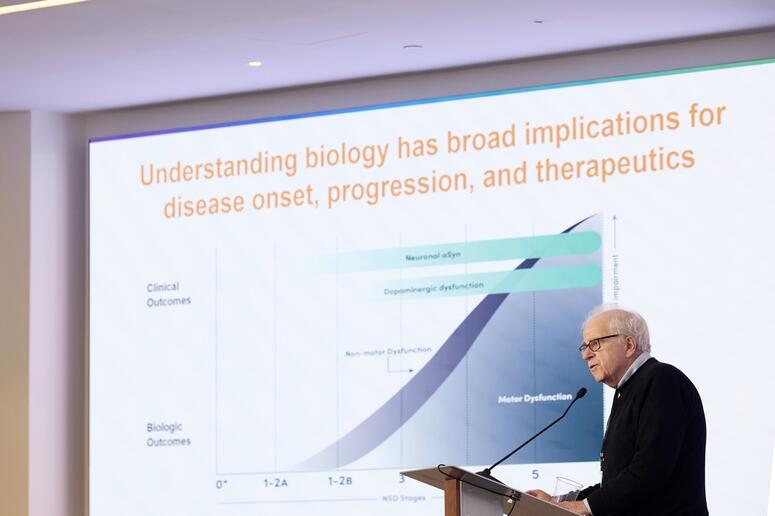
“Understanding the biology of how Parkinson’s begins and progresses allows us to move forward with therapeutics,” said Kenneth Marek, MD, PPMI principal investigator and co-founder of the Institute for Neurodegenerative Disorders. “The keys to success are innovation, commitment and collaboration. No one works in isolation.”
A New Horizon
Several promising topics emerged in this year’s meeting. While the data presented was early stage, they offer a foundation for new ways of looking at Parkinson’s.
Better Biomarkers
Identifying Parkinson’s biomarkers remains a core goal of PPMI, and validation of the alpha-synuclein test in 2023 was a breakthrough. However, “the alpha-synuclein seed amplification assay is important but not enough,” stated PPMI investigator Tanya Simuni, MD. “We need quantitative biomarkers.”
Such biomarkers that go beyond the existing “yes/no” categorization can help accurately measure varying levels or degrees of the disease. Through intense data blitzes, many teams offered fresh ideas. As PPMI researcher Kalpana Merchant, PhD, explained, “We’re taking multiple shots on goal.”
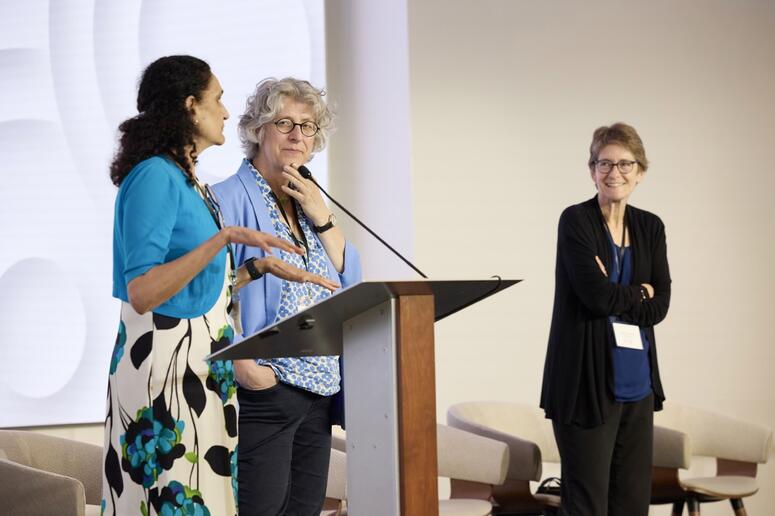
These ranged from developing better ways to measure alpha-synuclein, including in the blood and skin (which would spare the need for lumbar punctures to get spinal fluid samples), to looking at markers that flag changes in the immune system and other cell activities.
Biomarkers also may help find those at higher risk of a Parkinson’s diagnosis, in hopes of identifying windows of opportunity to prevent or slow disease onset. PPMI researcher Anat Mirelman, PhD, used wearable sensors to collect mobility data and found that at-risk participants may have early changes that are detectable with digital health technology. More research is underway in this area, with additional sensor projects starting in the coming months.
Refined Staging Systems
Across presentations, researchers offered insight into potential ways to improve the staging system for Parkinson’s, the NSD-ISS, (or neuronal alpha-synuclein disease integrated staging system), which categorizes participants based on biology for research (not clinical or diagnostic) purposes. Without a clear way to separate participants across defined stages of Parkinson’s, it is difficult to look for helpful trends. For instance, a graph with datapoints from all PPMI participants can look like a sea of random dots, but when separated by different NSD-ISS stages, quickly turns into clear lines that scientists can use to inform their work. This precision medicine approach to data creates what one presenter called a “renaissance” in terms of how an existing research technology can now be applied to Parkinson’s.
Improved Imaging
Imaging is another area where PPMI researchers are advancing the field. Imaging technology is improving with better resolution that allows researchers to see parts of the brain such as the substantia nigra (where dopamine-producing cells are located) more closely. PPMI researchers are also developing new types of imaging tracers to track Parkinson’s progression in living people. When combined, these advances open doors for understanding what happens in the brain over time across different people with Parkinson’s.
According to MJFF’s Jamie Eberling, PhD, “We are moving from hope to reality, and currently, we are somewhere in between.”
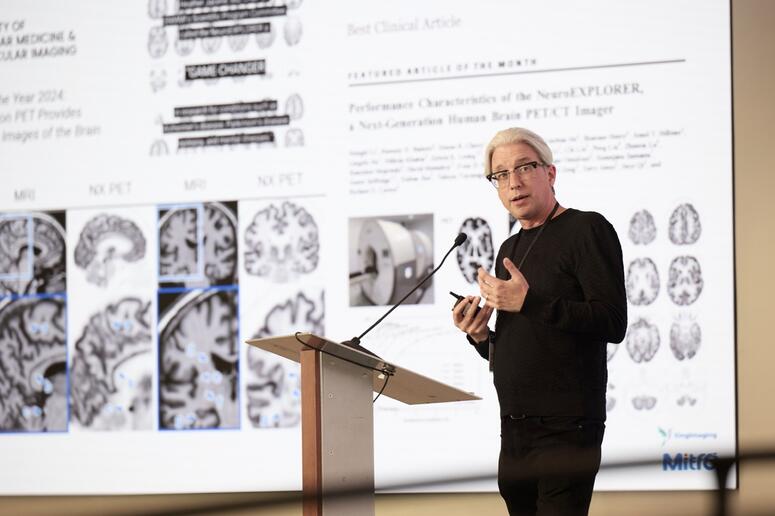
PPMI researcher Roger Gunn, PhD, presented DaT (dopamine transporter) scan data to visualize the loss of dopamine neurons over time. His model may create a “dopamine clock” that assesses trajectories of dopamine loss, including how early that loss occurs before symptoms. Such a tool would help researchers understand disease progression and learn how people transition between disease stages.
Clearer Understanding across Diseases
Parkinson’s and Alzheimer’s disease can share symptoms and biology. Parkinson’s researchers are looking across diseases to study memory and thinking issues.
Several PPMI presentations explored markers of abnormal tau, a protein commonly linked to Alzheimer’s. Though new, these avenues open the possibility of applying validated tau tests to understand Parkinson’s. Such advances also tie into precision medicine. People with Parkinson’s and abnormal tau protein may have a different care or treatment journey.
Expanded Return of Results
The annual meeting also highlighted the easy-to-access online study portal myPPMI. Participants can share data on their health and disease, complete some tests (i.e., smell test or genetic screen) at home and view their own research information. Participants in the U.S. and U.K. can view results from their smell test, alpha-synuclein spinal fluid test, in-clinic motor signs test and DaT scan.

At this year’s meeting, CAB emeritus member Allen Dance — an early proponent of the return of research information — thanked PPMI, not only for returning this information but for doing so with careful consideration for all participants. The study team is working to bring such information to PPMI participants across geographies and languages, as well as working toward return of genetic and cognitive information in the myPPMI portal.
A New Future
“Quantitative biomarkers for neurodegeneration are rapidly becoming available,” shared Dr. Marek at a post-event meeting. “We’re shifting from thinking about Parkinson’s based on symptoms to Parkinson’s that is based on biology.”
In this future, a Parkinson’s physician can order several tests, and based on the results, will tailor a care plan. Data from PPMI will help turn this potential into reality.

That data comes from dedicated research participants enabling strides toward better therapies for those with Parkinson’s and — possibly — prevention. During a panel session with CAB members, Carey Hidaka shared his motivation to join PPMI in 2013. “I don’t want this to happen to my kids,” he said, as he also shared appreciation for treatment advances that helped him continue in the study.
Giving voice to both the gratitude and urgency felt by the Parkinson’s community, CAB emeritus member and MJFF Patient Council member Kevin Kwok simply stated: “Thank you — but remember, we are still waiting for a cure.”
To learn more about PPMI’s approach and impact, read a special PPMI journal issue from the Annals of Neurology, including an editorial from Michael J. Fox.
Learn more about how you can join the study that’s changing everything at michaeljfox.org/PPMI.