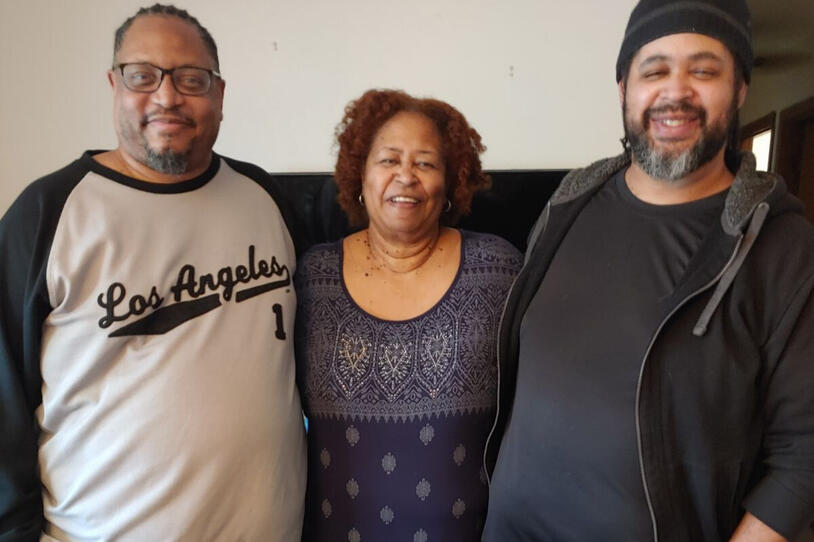
Toney Matthews and her sons, Cliff and Nick.
When Toney Matthews of St. Louis received her Parkinson’s diagnosis in April 2023, she was stunned. A retired accountant and mother of two adult sons, Toney hadn’t heard much about the disease and had been diagnosed with a list of other conditions. She now sees how the signs building for nearly a decade led to Parkinson’s disease.
After some months, Toney took action. She found the Black and African American Connections to Parkinson’s Disease (BLAAC PD) study and started contributing to research.
“I was lost when I first began my PD journey; I was in denial for months after my diagnosis. The BLAAC PD study gave me courage to embrace PD, help myself, and devote myself to research that will help Black patients,” says Toney.
Learn more about joining a research study and find the right fit for you.
Long Road to Diagnosis
Toney can trace the start of her symptoms to a car accident in 2012 that left her with a brain injury and lingering migraines. Her hands became rigid and tremors persisted.
“I used to do calligraphy, but I had issues holding the pen steady. That doesn’t work when you’re using ink,” she says. “I kept falling, hitting my head. My friends were threatening to buy me a helmet. I knew something was going on, but nobody was putting the pieces together.”
Doctors attributed her symptoms to aging, carpal tunnel syndrome and low blood pressure. She underwent surgery in both hands and did physical therapy. It wasn’t until her youngest son noticed her head shaking that things began to shift.
“He said, ‘Mom, your head is shaking.’ and encouraged me to get it checked out,” recalls Toney. A nurse practitioner tested her motor skills and referred her to a neurologist specializing in Parkinson’s.
Denial, Depression, then Community
“I didn’t even know what Parkinson’s was,” Toney says. “I went in for tremors and falls and was told I had this condition with no cure. I didn’t know what questions to ask. I was in shock.”
In the months that followed, she fell into depression.
“I was in my early 60s, working from home. I just felt so isolated,” she says.
Her friends encouraged her to connect with a local American Parkinson Disease Association chapter, and she attended a PD Essentials class. There she saw a flyer for the BLAAC PD study.
Research and a New Purpose
“I didn’t know research opportunities like this existed,” Toney says. “You always hear about Alzheimer’s or cancer, but never Parkinson’s — especially not something focused on Black and African American communities.”
BLAAC PD is a research study collecting blood samples and health information from Black and African Americans with and without Parkinson’s disease. The study is part of the Global Parkinson’s Genetics Program (GP2), a worldwide effort coordinated by The Michael J. Fox Foundation and partners to better understand the causes of Parkinson’s. The goal: uncover more ways to stop the disease that serves people of every background and experience. BLAAC PD is an initiative of the Global Parkinson’s Genetics Program (GP2), a resource program of the Aligning Science Across Parkinson’s (ASAP) initiative.
Washington University in St. Louis is one of 11 study sites in the U.S. Toney called and left her information and soon received a call back.
“They asked basic questions to see if I was eligible,” she recalls. “At that first session, I shared my PD journey and told the researchers to keep me in mind for future studies.”
Care and Trust from Study Team
Joining BLAAC PD wasn’t Toney’s first time in clinical (human) research. She had joined studies on flu vaccines and diabetes medications, so the process felt familiar.
“So, when they asked for a blood sample, I was fine with it,” she says.
In the study, volunteers spend about one hour with the expert medical team. They share a blood sample and health information. The study doctor may do some tests to measure disease. Travel costs are paid for by the study, and participants receive reimbursement for their contribution. The data from the study is de-identified (removing any information to link back to the person) and shared with scientists to speed discovery.
“I had little concern about data privacy,” Toney says. “Wash U’s reputation gave me confidence. From the start, I admired the study team’s enthusiasm and felt comfortable sharing my story. They explained every step and made sure I was comfortable.”
Her experience deepened her commitment. “With each invitation for additional research studies, I felt like this was something I can do to aid myself and others—discover and educate on PD while working toward a cure.”
When asked to join Washington University’s BLAAC PD Community Advisory Board, Toney was honored. “At first, I was intimidated by everyone’s credentials,” she admits. “But living with PD gives me a perspective that complements the clinical view. I know the questions patients have, and participating in BLAAC PD helps me provide answers and resources.”
She acknowledges the hesitation in her community. “There’s fear because of past abuses in research. It’s real, especially among elders. But we can reach younger generations and show that BLAAC PD is here to help individuals, improve lives, and one day find a cure.”
Looking Ahead
Toney is hopeful about the future—for herself and for others. She’s looking forward to events like MJFF’s PDIQ St. Louis in 2026, where she hopes to meet others in the community and continue spreading awareness. “I want to help more people get diagnosed and get involved in research,” she says. “We deserve answers, too.”
To learn more about how you can get involved in BLAAC PD call 1-866-274-1912 or visit blaacpd.org.