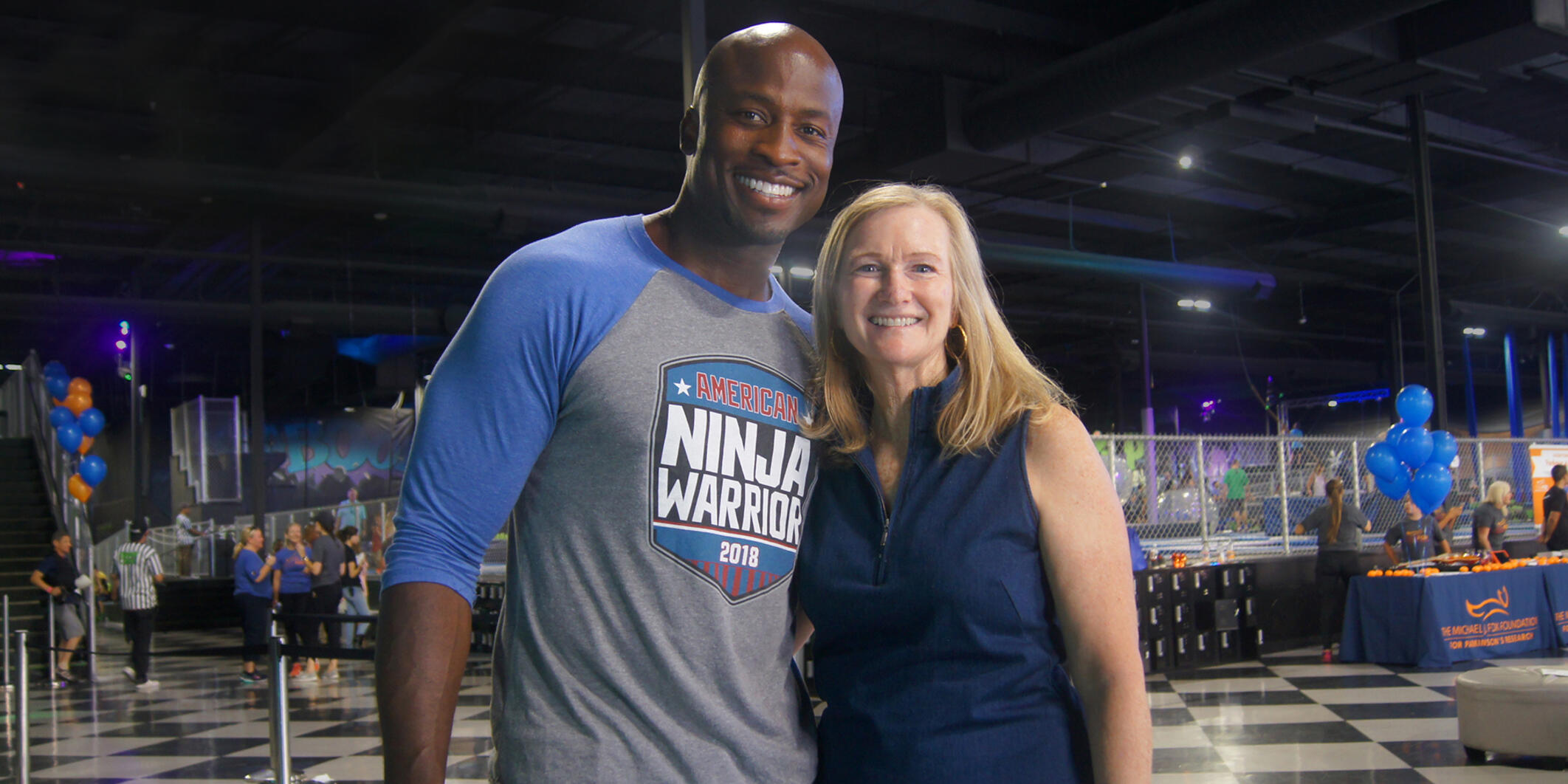
Community StoriesAkbar Gbajabiamila and MJFF CEO and Co-Founder Deborah W. Brooks.
Akbar Gbajabiamila
How This TV Host and Former NFL Star Is Using His Platform for Parkinson’s Research
Written by Kristina Rodriguez
You may recognize Michael J. Fox Foundation (MJFF) Board member Akbar Gbajabiamila from NBC’s “American Ninja Warrior,” from his NFL days as an Oakland Raider or as a former co-host on CBS’ “The Talk.” Today, Akbar is using his platforms to educate more people and families on Parkinson’s disease (PD) and the latest research.
As a son whose father has PD, Akbar opened up to sports online outlet The Athletic about the questions he has about his own risk for the disease and shared his latest efforts to mobilize people of all backgrounds to participate in the Foundation’s landmark study, the Parkinson’s Precision Medicine Initiative (PPMI).
To date, most Parkinson’s research has not been fully representative of all people who live with the disease. As a result, our understanding of how PD affects people living with the disease and their families across diverse backgrounds is incomplete. Clinical research must include underrepresented populations such as the Black and African American community so that the treatments and cures we seek benefit all people living with PD.
My hope is we can get more African Americans, more people of color to get involved in the research, to trust the process when it comes to this.
Overcoming Hesitancy and Building Trust
When asked about why he decided to share his story on getting involved in Parkinson’s research and using his platform to raise Parkinson’s awareness in the Black and African American community, Akbar emphasized: “I wouldn’t even lie when I say there’s always a concern, a question about having trust in the process. And with the relations with The Michael J. Fox Foundation, I was quickly able to get over the hesitancy of joining the [PPMI] research, what are they going to do and all the other stuff that pops up in your mind. Some of it is deeply rooted in the stuff that we’ve been exposed to, especially in the Black community. After I got through the survey part, I went, ‘Oh, that was easy.’”
In the exclusive story, MJFF Chief Program Officer Sohini Chowdhury explained the critical value people of all backgrounds bring to finding better treatments and the answers we seek: “Parkinson’s disease, like so many other diseases, our biological understanding of the disease is founded on individuals who are mostly Caucasian and mostly of Western European descent, and it’s extremely limited. It’s helpful, but it’s limited. We talk a lot about personalized medicine. It’s hard to be personalized if all your biological knowledge comes from a population that’s not similar to your own.”
Closing the Representation Gap
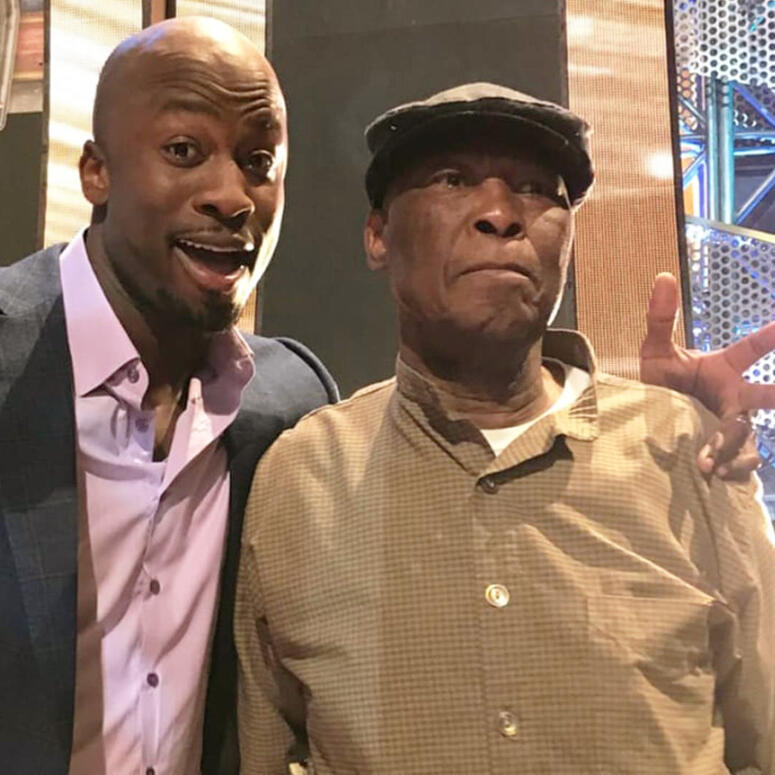
Akbar and his father on the set of "American Ninja Warrior." Photo courtesy of Akbar Gbajabiamila.
Akbar’s hope is that the findings from the PPMI study help scientists better understand how the disease starts and changes. And, that the information can help doctors and scientists better diagnose, treat and even prevent Parkinson’s disease not only for his family but for others. “My hope is we can get more African Americans, more people of color to get involved in the research, to trust the process when it comes to this. There’s information in our bodies that we hold that we just don’t know,” he said.
Today, PPMI is located around the world at 50 participating medical centers in 12 countries — including in Lagos, Nigeria (where Akbar traces his family heritage).
Increasing representation in Parkinson’s research is critical to building a more complete understanding of the disease. In addition to PPMI, the Black and African American Connections to Parkinson’s Disease (BLAAC PD) study, part of the Global Parkinson’s Genetics Program (GP2), is working to better understand the genetic changes that may contribute to Parkinson’s risk in Black and African American people and to address their longstanding underrepresentation in research. GP2 is a resource program of the Aligning Science Across Parkinson’s (ASAP) initiative that is funded by the Sergey Brin Family Foundation and implemented by MJFF.
“I’m not interested in holding the credibility for myself. I want to be able to use it to hopefully amplify other people’s lives and change people’s lives. And I’m hard on myself. I feel like I can still do more,” said Akbar.
Join the Parkinson’s Precision Medicine Initiative
If you’ve been recently diagnosed with Parkinson’s, you can play a critical role in our landmark study. Call 877-525-PPMI or email joinppmi@michaeljfox.org to get started. PPMI is open to anyone age 18 and up in the U.S.
We use cookies to ensure that you get the best experience. By continuing to use this website, you indicate that you have read our
Terms of Service and Privacy Policy.