

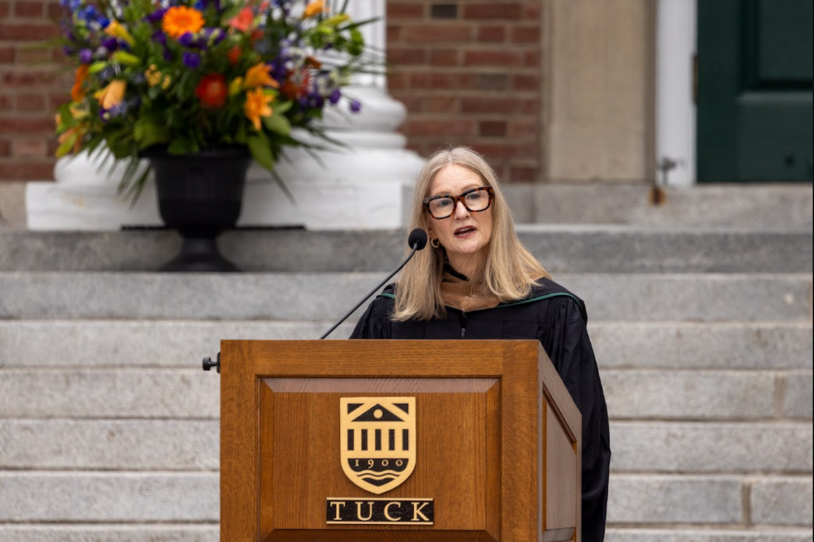
MJFF’s CEO and Co-Founder Debi Brooks delivers remarks during the Tuck School of Business at Dartmouth’s 2026 investiture ceremony. Photo Credit: Rob Strong.
In case you missed it, last month The Michael J. Fox Foundation (MJFF) CEO and Co-Founder Debi Brooks delivered remarks to the MBA Class of 2026 at Dartmouth’s Tuck School of Business investiture ceremony.
A member of the Tuck Board of Advisors and a Tuck alumna herself, Debi returned to campus 40 years after her own investiture to share lessons from her career, her partnership with Michael J. Fox and the journey of building MJFF into the world’s largest nonprofit funder of Parkinson’s research.
Watch the video and read her remarks below.
Debi Brooks’ Remarks to the Tuck MBA Class of 2026
Good morning, Dean Slaughter, faculty, families, and most importantly — graduates. It’s an honor to be with you today.
Here’s a little-known fact about being asked to give an address like this:
Everyone you’ve ever met has an opinion about what a great commencement speech sounds like, and they will all send you (unsolicited) the most celebrated speeches found on YouTube. I received a wide variety of examples, from Eric Schmidt to Eric Church.
Those speakers set a high bar, but being a Tuck graduate, I rise to the challenge. So, let’s begin.
Whenever I tell my story to MBA students, I’m acutely aware that it’s far from a blueprint for others to follow. People are often curious about my path to Tuck, and especially the atypical career that came after. Indeed, my post-grad trajectory turned out to be more unexpected and thrilling than I could ever have imagined.
Most of you have a plan for what lies ahead. Some of you will prove to be prescient, but for the majority, you’ll learn that there is no app that tells you where to turn, backtrack, or avoid the route that requires tolls. What comes next, and next after that, is going to be part of the adventure.
When I arrived in Hanover nearly 40 years ago (yikes!), I was barely 25 years old and felt equal parts gung-ho and out of my element. I was the first in my family to graduate from college and getting through William & Mary was already a win. A couple years later, I still lacked the slightest vision for a career that suited my skills and passions.
I was introduced to the concept of business school when then my roommate shared that she was working on B-school applications. Maureen had confidence and a plan. When I was eager to hear more, she was so clear-minded: She was going. She inquired after my GMATs and shrugged: “You’re smart. You should go too!” Then she scratched out a list of reach schools. My curiosity was sparked and off I went.
I visited a few — Harvard, Wharton — but when I got to Hanover, I knew my search was over. Tuck immediately felt like home, a new place where I could find my way and yet belong. Its reputation for turning out well-rounded leaders wasn’t even part of my calculus (although, I am pretty good at calculus). It was just the one for me.
By the time I graduated from Tuck, I was well prepared to embark on my own journey. Still, my offer to join Goldman Sachs’ Sales & Trading team was in no way pre-ordained — I was as surprised as anyone. And if you’d told me then that I would leave that coveted post after just nine years, I would’ve said, “What?!” (Most who knew me at the time said, “What?!”).
I loved Goldman. I loved my clients, my colleagues. But I couldn’t deny that in the midst of making all those profits, I found myself drawn toward something completely different: the nonprofit sector. I had an idealistic sense that philanthropy could be playing a more strategic role in solving some of the world’s biggest problems.
In today’s parlance, I wanted to be part of something purpose driven.
What was even more far-fetched was that this decision would soon lead to my helping launch a scientific nonprofit. I knew nothing about biomedical research. I had no personal connection to Parkinson’s, and how would one even tackle curing a disease?
But here’s what I stumbled into: Michael J. Fox.
It would be an understatement to say that the prospect of meeting — let alone partnering with! — “Marty McFly” had not been on my bingo card.
It turned out to be a dream you would never think to dream.
Like everyone, I’d seen the news that Hollywood’s biggest star was retiring from acting at age 38 to focus on curing Parkinson’s disease. A friend of a friend tipped me off that he was looking for a partner to lead the charge. Of course, I couldn’t know that the candidates he was meeting, while highly qualified, didn’t feel quite right to him. Even he hadn’t quite yet put into words what he was looking for: a business-minded partner who would quickly grasp his concept for a different kind of nonprofit, one that operated more like a startup.
From my first conversation with Michael, I immediately sensed in this nascent venture the rare privilege to be part of an honorable and worthy challenge. And simply put, he drew me in with his audacious vision.
In what way was it audacious? Let me share a story from our Foundation’s first board meeting. Michael looked around the room. With his brilliant communications instincts that I’d quickly gotten used to, he challenged group of wildly successful leaders:
“I’ve asked you to join me in this undertaking because I need your help — to go out of business.”
Not a goal one typically brings to a startup boardroom, or really any endeavor you’ve been trained for at Tuck. But sometimes the most challenging problems require rethinking your entire approach. Michael’s idea — to cure Parkinson’s as fast as we could and then close our doors — has guided us and inspired our community ever since.
Early on, Michael and I attended an event in Arizona hosted by the world’s most famous Parkinson’s patient, Muhammad Ali. PD had left him with diminished vocal capacity, but he thoroughly charmed us with his humor and grace. He was absolutely thrilled that Michael and I had pushed our way onto the disease-curing scene. Though he knew the task would be daunting, there was a twinkle in his eye: Our success would depend on disrupting the status quo. On our final day of the trip, Muhammad pulled me aside and presented me with an autographed boxing glove. He whispered to me, “You’re going to need this.”
Boy, was he right.
At the time, Parkinson’s research faced no shortage of boulders to be pushed up hills: a stalled drug pipeline, next-to-no pharmaceutical industry investment, and a medical research system producing painfully few insights into the “black box” of disease biology. And even though the Foundation was pretty fast out of the gates in fundraising and awareness building, our resources in those early years were a drop in the bucket compared to the annual U.S. (and global) public and private outlay for drug development.
It was my job to harness Michael’s singular vision into an organization that could move the dial.
I landed on a simple but critical question: What if we treated curing Parkinson’s like a business problem? What if we built our own on-staff team of PhDs and a few MBAs who could identify and fund promising ideas earlier, take risks others wouldn’t, move fast, learn, and redirect donor dollars toward what worked? What if we focused less on how much capital we had — and no matter how much capital we had — how we could deploy it most strategically?
I had taken the job thinking it was mainly about funding research. But it didn’t take long to appreciate this:
It isn’t hard to fund research. What’s hard is to fund research smartly.
Perhaps, given that it was Michael, I shouldn’t have been surprised that experts tolerated seemingly basic and, in some cases, challenging questions from us.
Questions like:
Why can’t philanthropy fund pharma to incentivize making drugs patients need?
If an entire field is stymied by a set of common challenges, why can’t we work together toward solutions that would propel everyone forward?
Why isn’t there more emphasis on scientific collaboration rather than competition?
Why wouldn’t you expect to be sharing your data?
Turns out, our approach was different. We got some meaningful traction, and $3 billion in research later this is a field transformed. The velocity towards a cure for Parkingson’s is real. Today the Fox Foundation is the number one funder of Parkinson’s research in the world — this year we plan to make $700 million in new grants, about twice the U.S. government — and we are a powerful and pace-setting example of the role philanthropy capital can play in de-risking drug development.
While our work is far from done, we’ve helped crack open the biology of the disease, attract wide-ranging partners and pharma into the space, change how people think about funding science, and ignite a global community — millions of patients and families who are now a powerful part of the solution they seek.
My message to you today is not really about the success of the Fox Foundation, although I’m proud of that, and our progress is meaningful to people all over the world who live with Parkinson’s.
Instead, my appeal is an invitation to be open about how you are going to make your mark. I’ve often heard Dean Slaughter say, “The world needs more Tuck.” I wholeheartedly agree. Tuck attracts extraordinary people. Each of you will continue to set yourself apart. You’re about to become part of organizations that will be defining success for you — title, compensation, recognition. Those are real markers, and you will earn them.
But you may get there and still feel an itch: “What’s my next challenge? Am I feeling fulfilled?” It is entirely possible to cultivate a successful, even enviable, career, yet still feel something is missing. Those feelings shouldn’t be pushed away — they’re a good thing. They keep you learning and seeking your path to something deeper.
Tuck has given you much: This community, these skills and relationships. Make the most of them, not just in the pursuit of capitalistic ideals, but in making room in your life to also give, serve and solve problems in the wider world around you. I appreciate that most of you are not going to end up in a job that looks like mine (although it’s an awesome one). But we have this in common: you hold the keys to the joy of both forging a successful career and making a meaningful impact.
A much-revered time traveler once said: “Roads? Where we’re going, we don’t need roads.” Lucky for you, Tuck has set you on a great course. The journey is still yours to craft.
Congratulations, Class of 2026. Safe travels and be bold.
Photo Gallery
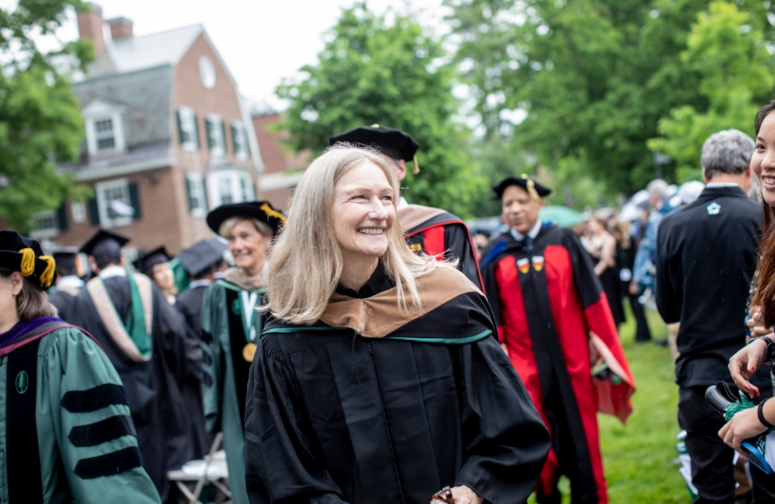
Photo Credit: Rob Strong
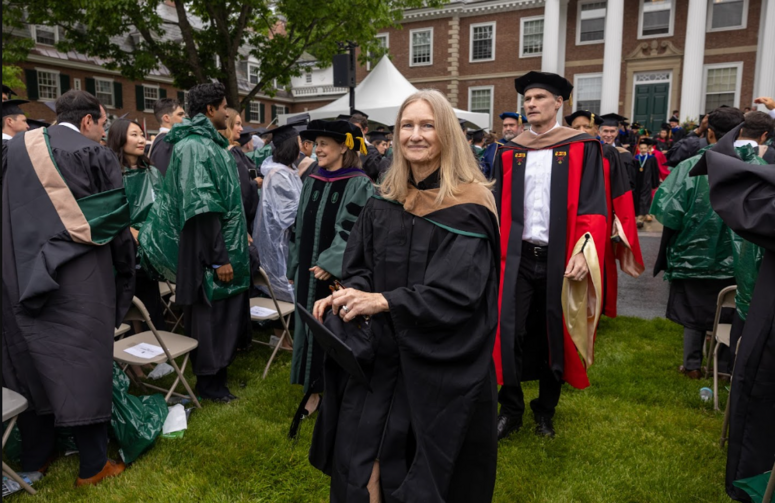
Photo Credit: Rob Strong
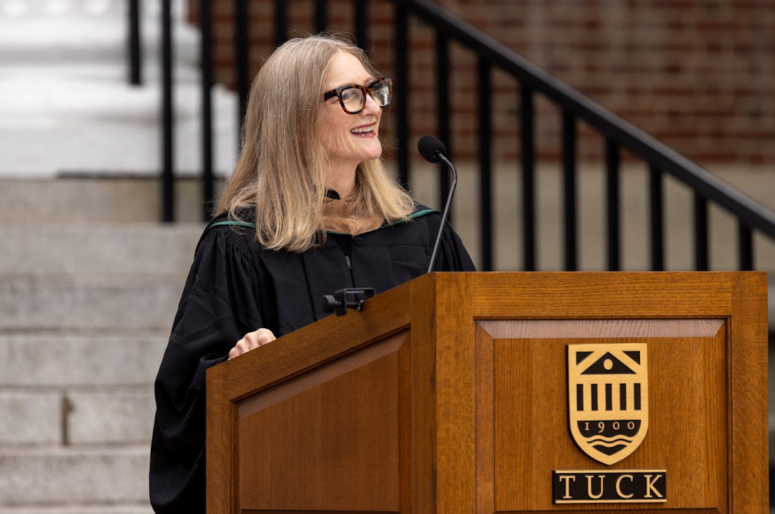
Photo Credit: Rob Strong
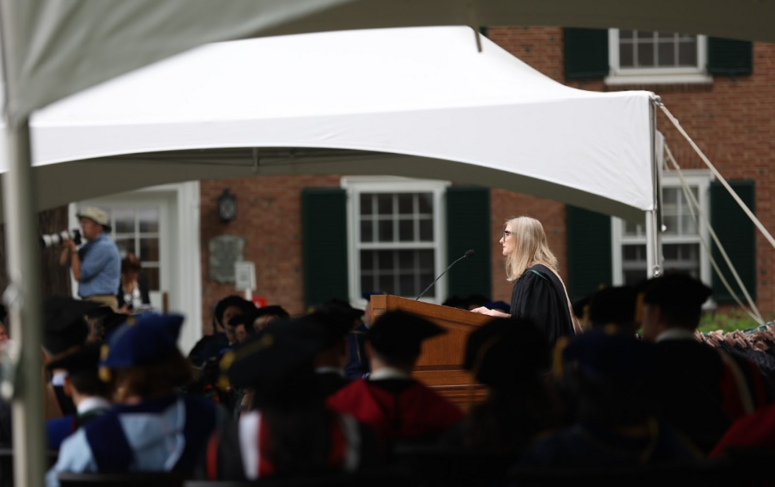
Photo Credit: Rob Strong