

The Therapeutics Pipeline Program accelerates new Parkinson’s therapies from discovery through clinical testing. By investing at critical stages of development, the program helps promising treatments overcome key scientific and financial hurdles and move closer to patients.
The Therapeutics Pipeline Program (TPP) funds promising Parkinson’s disease (PD) therapies from preclinical through clinical testing. By providing strategic investment at critical development points, The Michael J. Fox Foundation (MJFF) helps ensure that experimental therapies with strong potential continue advancing toward patients. The program supports researchers in generating the evidence needed to demonstrate therapeutic impact, inform key development decisions and attract follow-on investment to keep the Parkinson’s drug development pipeline moving forward.
TPP works with other MJFF programs, such as the Target to Therapies initiative, which builds and validates evidence for promising but understudied therapeutic targets, and the LRRK2 Investigative Therapeutics Exchange (LITE), a global collaboration designed to fast-track LRRK2-targeted therapies and optimize biomarkers. Together, these efforts create a path from target validation to streamlined clinical testing.
-
Why the Therapeutics Pipeline Program Exists
Developing new Parkinson’s therapies is complex, expensive and high risk. Many promising programs stall before reaching key value-driving milestones due to limited access to capital.
Through TPP, MJFF provides funding primarily to biotech and pharmaceutical companies or academic-industry partnerships. MJFF may also fund academic-only projects in certain cases. The goal is to advance therapeutics with strong scientific promise to support their development and bring them to people living with Parkinson’s.
MJFF’s “de-risking” strategy:
Supports essential pre-clinical and proof-of-concept clinical studies to help move potential treatments forward
Builds strong partnerships with biotech and pharmaceutical companies and connects them with resources to expedite their efforts
Helps attract additional investment to advance the most promising treatments
Beyond funding, MJFF de-risks programs by integrating them into its broader research ecosystem, including access to resources such as the Parkinson’s Precision Medicine Initiative (PPMI). TPP grantees also benefit from connections to a range of resources — including preclinical tools, biosamples and a network of Parkinson’s experts. TPP-funded researchers also have access to clinical trial design guidance, biomarker expertise and connections to experienced sites, strengthening study execution and accelerating regulatory and partner engagement.
Program Focus
TPP supports the development of both drug and non-drug approaches, funding research from early drug screening through proof-of-concept clinical trials. The program backs projects that target many different aspects of Parkinson’s biology, helping build a strong and diverse pipeline of potential treatments to meet the wide-ranging needs of people living with the disease.
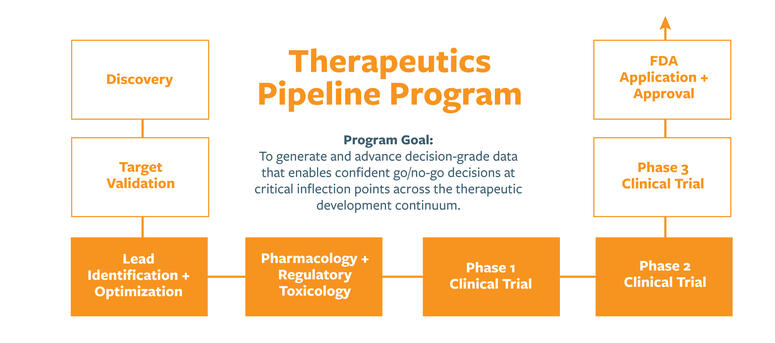
The program funds projects that aim to:
- Slow, stop or prevent disease progression
- Improve symptoms and quality of life, including both motor symptoms (like tremor and stiffness) and non-motor symptoms (such as sleep, mood and cognition)
- Support integration and analysis of decision-informing biomarker tools
The program invests in a wide range of therapeutic strategies, including:
- Medicines, such as small molecule drugs, biologics and gene therapies
- Non-drug approaches, such as surgical techniques, brain stimulation and other technology-based treatments
- Repurposed therapies (existing drugs being tested for Parkinson’s) when there is strong evidence and a clear plan to measure their impact
Funding spans the full development pipeline, including:
- Early-stage research, such as identifying and refining potential therapies and understanding how they work
- Clinical studies in people with Parkinson’s, focused on safety and early signs that a treatment may be effective
A key priority of this program is the use of biomarkers — measurable indicators in the body that help researchers understand disease and treatment effects. The program supports projects that use biomarkers to:
- Show that a therapy is working on its intended target
- Help determine the right dose
- Guide clinical trial design and decision-making
- Identify which patients are most likely to benefit
The program supports projects advancing a broad range of key biological targets and therapeutic mechanisms implicated in Parkinson’s, including but not limited to the following:
- Endolysosomal dysregulation: The endolysosomal system helps cells sort, transport, recycle and clear unneeded materials. In Parkinson’s, dysfunction in this system may allow cellular waste and misprocessed proteins, including alpha-synuclein, to build up and contribute to disease progression.
- Inflammation and immune cell regulation: Inflammation helps the body respond to injury and disease. In Parkinson’s, overactive or poorly regulated immune responses may damage healthy cells, and researchers are studying how these pathways contribute to neurodegeneration.
- Mitochondrial dysfunction: Mitochondria produce energy and help maintain cell health. In Parkinson’s, damaged mitochondria may accumulate when quality control processes such as mitophagy fail, contributing to dopamine neuron loss.
- Neuroprotection: Neuroprotection aims to help brain cells survive and function despite disease-related stress. Researchers are studying survival pathways, including those supported by growth factors, that may strengthen vulnerable neurons and slow disease progression.
- Protein aggregation: Proteins such as alpha-synuclein can misfold, stick together and form clumps in Parkinson’s. Researchers are studying alpha-synuclein biology, ways to measure it, and therapies for people with evidence of misfolded alpha-synuclein.
- Symptomatic approaches: Parkinson’s causes motor symptoms, such as tremor, slowness, stiffness and balance problems, as well as non-motor symptoms, such as sleep, mood and cognitive changes. These symptoms may stem from the underlying cellular changes described earlier.
Because this program is focused on advancing treatments toward real-world use, the program does not support:
- Very early discovery research without a clear path to a therapy
- Studies that do not have a realistic plan for developing a treatment
- Biomarker research that is not tied to a specific therapeutic program
- Minor reformulations of existing drugs without a strong reason they would better address patient needs
- Studies of dietary or nutritional supplements
- Observational studies that do not test a therapeutic approach
-
Funded Industry Programs
Through strategic investment and collaboration, TPP is building a diverse portfolio of high-impact studies. Each funded project plays a critical role in driving innovation and delivering measurable results.

(Funded preclinical industry programs since 2025. This list is not exhaustive of companies MJFF is supporting or collaborating with across other programs.)
Partner with Us
Are you advancing an innovative Parkinson’s therapy and seeking strategic funding support?
Have questions about project suitability or the application process?
- Contact us at grants@michaeljfox.org.
- Learn about TPP funding opportunities.
- Sign up for MJFF emails to receive the latest funding news.
Success Stories
Read about select program successes in the following articles:
-

How Strategic De-Risking is Fueling Parkinson’s Treatment Development
“De-risking isn’t just about funding early science — it’s about giving promising ideas the support they need to mature and demonstrate their value,” says Shalini Padmanabhan, PhD, head of translational research at MJFF.
-

Paving the Way for Groundbreaking Discoveries
“This is why our Foundation exists,” says Todd Sherer, PhD, MJFF Chief Mission Officer about the Foundation’s de-risking strategy. “We’re here to take the risks, fund new ideas and help build the data to encourage vital partnerships down the road.”